Remote working was a slight trend before the coronavirus strike in 2020. The pandemic that followed made this trend bigger.
As you can see from the above graphic, only 15–16 employees, up to 100, were working remotely before the pandemic. Nearly half of the employees work in this state during and after the pandemic!
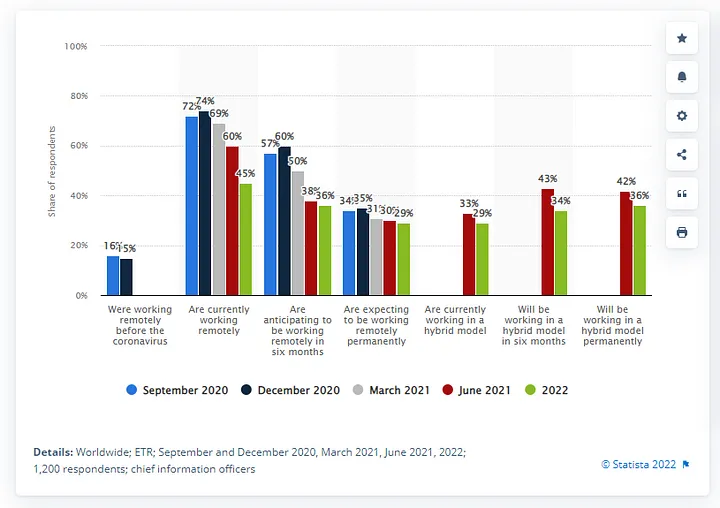
Image from Statista¹
Those employees who engage in such ways of doing their work are called digital nomads. Many even work on subtropical islands, although this is not as fancy as it sounds².
But it is not only about work. It is about everything; fun, games, traveling, eating, dating, etc. As long as there is an internet connection, options, more than ever, are unlimited.
Nowadays, communication is based on cloud computing. More and more companies trust their data on cloud computing, which reinforces its usage. The following graphic is apocalyptic :
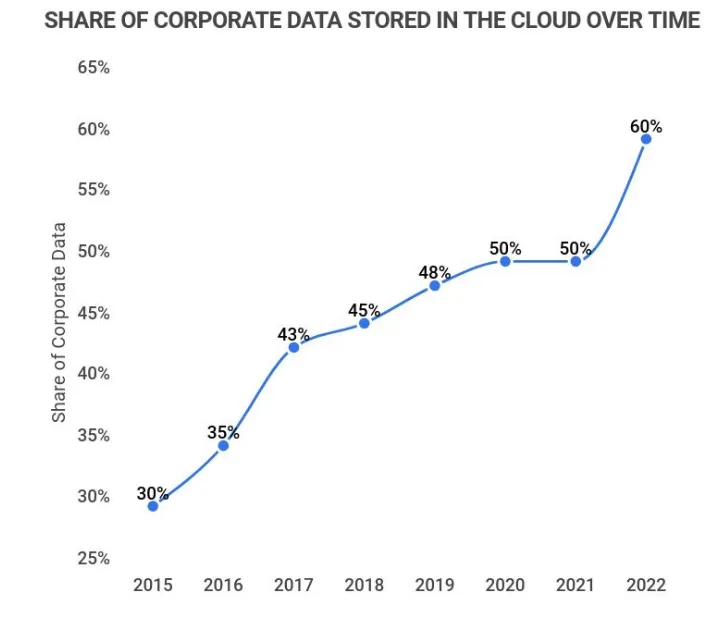
Image from Zippia³
From the same resource, we read⁴ :
- The average employee uses 36 cloud-based services every day.
- With over 200 cloud services that fall under the category of collaboration (e.g., Dropbox, Microsoft Teams, or Google Suite), it’s no surprise that employees use several of these services daily.
- The average enterprise uses 1,295 cloud services.
- In 2016 that number was 1,022, meaning the number of cloud services used by enterprises increased by 26.7% in less than five years.
The same trend follows the adoption of apps on mobile phones. From Statista comes the next indicative table⁵ :
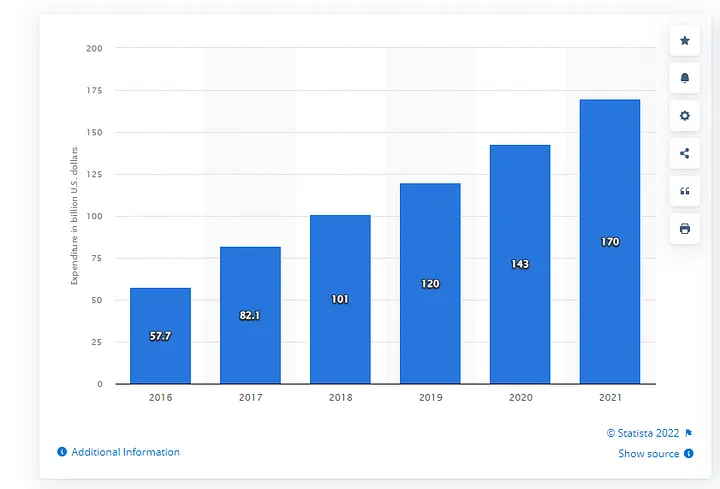
Image source: Statista: Worldwide consumer spending on mobile apps from 2016 to 2021(in billion U.S. dollars)⁵
Your mobile or your mobile device is now your office, the place where you do all the work you need. You have apps and software like M.S. Office and Gmail to do your core work, more specialized ones like Autocad and Solidworks for engineers, Adobe photoshop, Canva for designers, and so on.
But it is also your home office which was usually the kitchen table in the past. You have apps for organizing your household duties, like shopping lists, paying the bills, watching remotely through cameras, turning off devices connecting to the web, and so on.
Moreover, your mobile is also your connection with the rest of the world. You have apps for news, for the weather, for finding which restaurant you are going to eat at, which hotel you are going to stay in, which movie you are going to watch, which friend to talk to and connect with, which person to date, how to exercise like being on the gym, etc.
Your only tool that dramatically increases your productivity is your mobile device, a cell, a tablet, or a laptop. You do more, not with less but with one! How fantastic is that? Especially when you compare this ability with the past when you had to do all these above with many tools like pen, rubber, paper, calculator, magazine, newspapers, television, letter, virtual office, and most importantly, people.
You can do all these activities without being in a particular place like an office or desk or using a unique tool like a telephone; you can be anywhere!
In this state where you can be in mobility and do activities that you could do while being in stability, I choose to call it “Mostability”; mobility+stability. The stable thing that you can do a variety of activities is a cell phone, a tablet, or a laptop is now a mobile device.
You do everything everywhere. You perform bank activities that, in the past, you had to visit your local bank to do them.
You do everything everywhere, which is the ability to do the most you can do. That’s another way to define “Mostability”; most+ability.
Of course, “Mostability” comes with a price.
“Today’s ever-expanding work tech — designed to increase employee connectivity and productivity in the age of remote work — is a key culprit in the stress and burnout epidemic. According to Zapier, roughly seven in 10 Gen-Z (71%) and Millennial (69%) employees admit they are constantly on or checking their work communication tools outside of work. Additionally, roughly one-third of Gen-Z employees (33%) and almost two in five Millennial employees (39%) say they check their work email/messaging tools more than they check their social media.”⁶
The era of “Mostability” is the era of burnout and all the related health issues.
When you can do more, you think that you can have more. The more you can have, the more you crave. This reinforcing feedback loop, as systems thinkers name it⁷, is the ancestral dopamine circuit.
The circuit is overloaded by all this exposure to social media, information, and hopes of achievement. Pleasure and pain, comfort and discomfort are constantly and rapidly interchange, so many people end up at the end of the day empty of vital energy. The dark side of “Mostability” is addiction; living in a world of overabundance, the more we have, the more we want⁸.
“Mostability” is like the moon, with one side on the light and one on the dark. No matter on which side you are, navigate with caution since the lack of gravity, as astronauts know, can cause you health issues.
References
[1].https://www.statista.com/statistics/1199110/remote-work-trends-covid-survey-september-december/
[2].https://www.ft.com/content/231c6d32-11bd-4035-84e1-14d93417941a
[3].https://www.zippia.com/advice/cloud-adoption-statistics/
[4]. Same as [3].
[5].https://www.statista.com/statistics/870642/global-mobile-app-spend-consumer/
[7].https://thesystemsthinker.com/anatomy-of-a-reinforcing-loop/